Last updated: April 19, 2026
I spent a weekend with Claude Design, and the biggest shift was not speed
It is genuinely impressive, but what stayed with me more were the questions around design systems, product moats, and enterprise boundaries in research preview.
TL;DR
Key takeaways first
>What struck me most about Claude Design was not just nicer output, but how tightly the path from description to prototype to handoff is connected.
>In the AI era, design systems matter more than surface style because weak structure pushes output back toward the average.
>As design and implementation get cheaper together, product moats, collaboration boundaries, and security assumptions all need to be rethought.
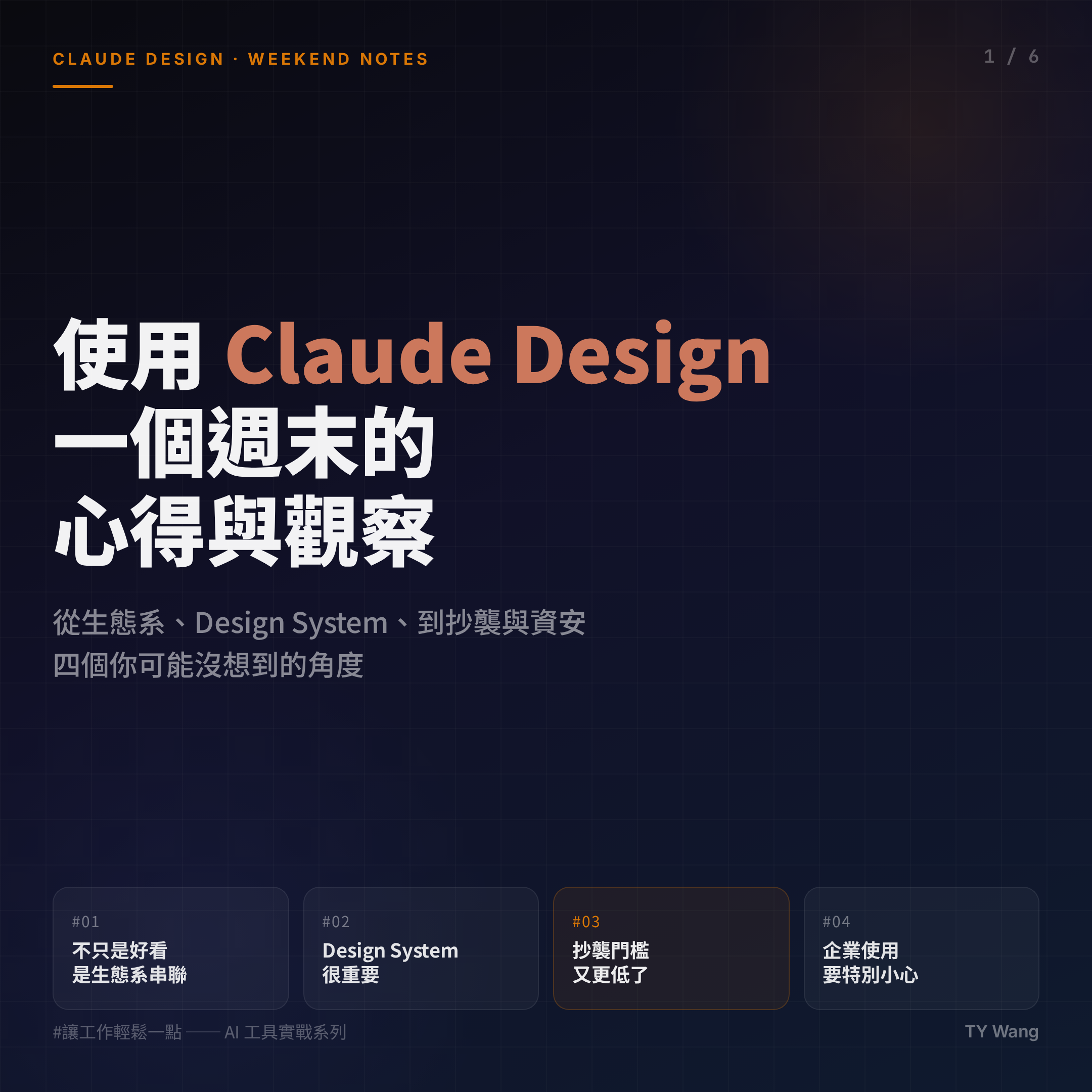
I spent a full weekend playing with Claude Design, and a few thoughts stayed with me.
Claude Design is Anthropic's new research preview product positioned as an AI-native design tool. You describe what you want in natural language, it generates an interactive prototype, and the export is not just an image. It is runnable React and CSS.
That part is genuinely impressive.
But halfway through, the question in my head was not only "design just got easier."
It was a much older question: did copying products just become easier too?
1. The interesting part is not only prettier output. It is the connected path.
The most common comparison right now is probably Google Stitch.
From my own hands-on impression, Claude Design's biggest difference is not simply visual polish. It is that more of the path is connected. You can move from description to prototype to handoff with much less of the old gap between design and implementation.
The design artifact itself starts to feel closer to something engineering can actually run.
That is why I think the real competition here is not only "which design tool looks better."
It is "how complete is the path from idea to launch?"
2. Design systems matter even more in the AI era
After two days of experimenting, one pattern became obvious.
If you do not provide a design system, or if your spec is too vague, the output still drifts back toward the same average-looking zone as everyone else.
I saw this in community examples, and I saw it in my own quick experiments too. Similar palettes, similar fonts, similar layout energy.
That reminded me of a recent internal workshop I gave about AI-assisted presentation design. The original topic was slide systems, but the lesson maps directly here: in the AI era, structured input is what creates distinctive output.
Claude Design becomes much more powerful when you already have a strong design system.
Without one, you are often circling around a higher-quality average, but still an average.
3. The barrier to copying products probably did get lower
This was the part that hit me the hardest.
Once Claude Code arrived, copying the shape of an existing product was already getting easier if you used it well. Claude Design lowers that bar again.
As someone who has seen products copied more than once while building companies, this part feels especially tangible to me.
And the harder truth is that a copy does not even need to be extremely faithful anymore. If AI can restyle it just enough, the result already starts to feel like "a different product" to many people.
In that world, surface appearance becomes a weaker moat.
So the real question becomes more fundamental: what are the moats left in software?
Data? Deep workflow integration? Domain understanding? Customer trust?
I think that is one of the more interesting questions to keep thinking about over the next few years.
4. Enterprise use deserves extra caution while this is still in research preview
I also spent some time probing the current collaboration and security edges, and my takeaway is simple: personal prototyping looks fine, but enterprise use deserves caution.
At this stage, the things I would want teams to understand early include:
- collaboration is still evolving
- sharing and handoff are convenient, but they also create boundary questions
- governance features such as audit visibility and usage oversight are not yet the whole story
- asset handling and storage behavior need to be understood before sensitive work goes in
None of that means the tool is unusable.
It means the product is still in research preview, and people should treat it accordingly.
For personal experimentation and prototypes, that is fine.
For sensitive client work or formal design assets, I would still be cautious.
Closing Note
Overall, Claude Design really may be one of those important inflection points for design tools.
But because of that, I keep reminding myself of two things.
First, in the AI era, design systems and domain depth matter more than surface visuals.
Second, the definition of a product moat is being rewritten.
That matters for founders, CTOs, designers, and product teams alike.
PS
If I keep writing about this, the next question I want to unpack is probably this one: once both design and implementation get easier, what is actually left of the software moat?