Last updated: April 10, 2026
Your first AI agent is probably simpler than you think
Most of the time you do not need a mystical framework. You need a clear task, the right inputs, a small toolset, and explicit rules.
TL;DR
Key takeaways first
>The first useful AI agent most people need is simpler than it sounds: clear task, clear tools, clear rules, clear boundaries.
>Many problems are better solved with fixed workflows, and an agent only becomes valuable when the next step truly needs dynamic judgment.
>This article is about lowering the starting threshold so AI agents feel buildable, not mystical.
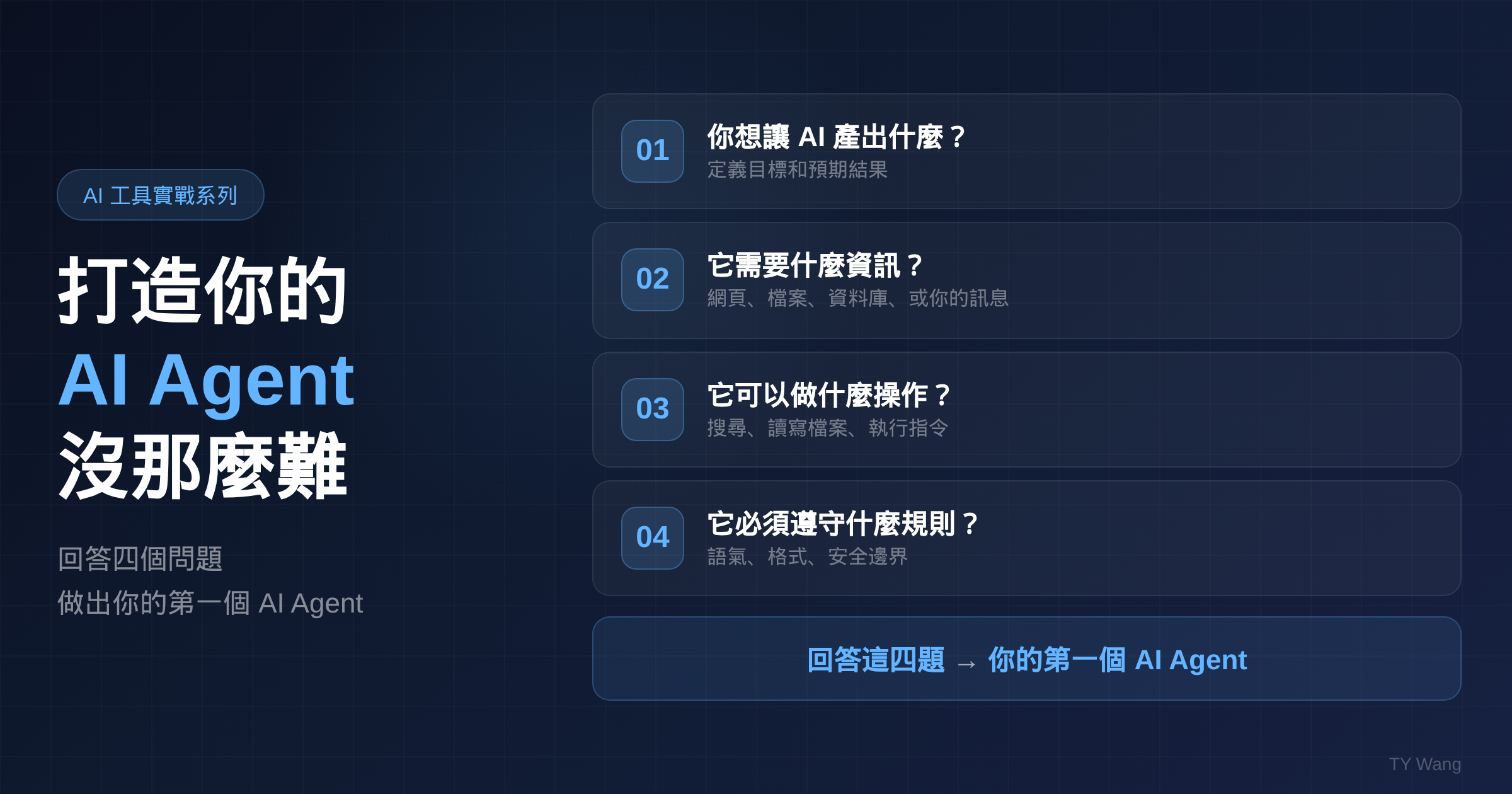
The phrase "AI agent" sounds much bigger than it often is. It makes people imagine complex frameworks, multi-agent systems, and vector databases before they are even allowed to start.
But after building a few of these myself over the past months, I keep coming back to the same conclusion: the first useful agent most people need is much simpler than they think.
1. The core loop is actually very simple
At the lowest level, an agent does something pretty straightforward.
You give it a goal. The AI decides whether the next step should be answering, reading, searching, or calling a tool. Then it looks at the result and decides what to do next.
That loop just repeats.
So most of the time, the real challenge is not whether you know a fashionable framework. It is whether the task, tools, rules, and boundaries are clearly defined.
2. Most problems do not need a full agent
This is the point I think gets missed the most.
Many tasks are handled perfectly well by a fixed workflow: clean the input, classify it, produce the output, or run a few steps in parallel and merge the result. That is workflow design, not necessarily agent design.
An agent becomes more valuable when the system truly needs to decide dynamically what the next step should be based on what it finds.
So instead of chasing the most agent-shaped architecture from day one, it is better to ask whether the problem really requires dynamic decision-making at all.
3. Let AI help you design the AI
One of my favorite moves is not starting from a blank page.
I often hand the idea to Claude or ChatGPT and ask it to help structure the first version:
- what result am I trying to get
- what tools are needed
- what rules must be fixed
- what failure cases should be tested
The value is not that AI replaces your thinking. The value is that it compresses a vague idea into something concrete enough to build.
4. More tools usually make the system worse
A lot of people start by stuffing the agent with as many abilities as possible, as if more capability automatically means a better system.
My experience has been the opposite. Fewer tools with clearer boundaries make for a more stable agent.
Each tool should do one thing. Reading is one tool. Writing is another. Sending a notification is another. Once responsibilities blur inside tools, the agent's judgment also gets blurrier.
5. Start from one clear job
If you want to build your first agent today, I would start from one focused task instead of one giant ambition.
For example:
- summarize meeting notes
- turn a rough thought into a draft
- read a specific folder and produce a report
Get one job working reliably first, then add more tools, more memory, and more complex decisions later. That is much more realistic than trying to build a universal assistant immediately.
6. Four questions are enough to begin
For a first agent, I think the most important thing is to answer these four questions clearly:
- what final result should the AI produce
- what information does it need
- what tools can it use
- what rules must never be broken
If those four answers are already clear, the hardest part is probably done.
Closing note
The more of these systems I build, the more I think most people are not blocked by technical difficulty. They are blocked by the aura of the term itself.
Useful agents do not have to be flashy or complicated. They just need to turn the working logic already living in your head into a system AI can reliably carry forward.
PS
Sometimes the best agent is not the one with the longest feature list. It is the one you are actually willing to trust with real work every day.