Last updated: March 26, 2026
How did a non-engineer ship 263 commits with AI in 30 days?
Once AI lowers the cost of execution, the scarcer skill becomes planning, judgment, and knowing what should happen first.
TL;DR
Key takeaways first
>As AI lowers the cost of execution, the scarcer skill shifts toward planning, judgment, and orchestration.
>The 'engineer who does not code' is not anti-technical. The role is becoming more about framing problems, sequencing work, and validating direction.
>This article is really about a shift in operating leverage, not a clickbait claim that engineers disappear.
How did a non-engineer ship 263 commits with AI in 30 days?
The most interesting part is that he is not actually an engineer.
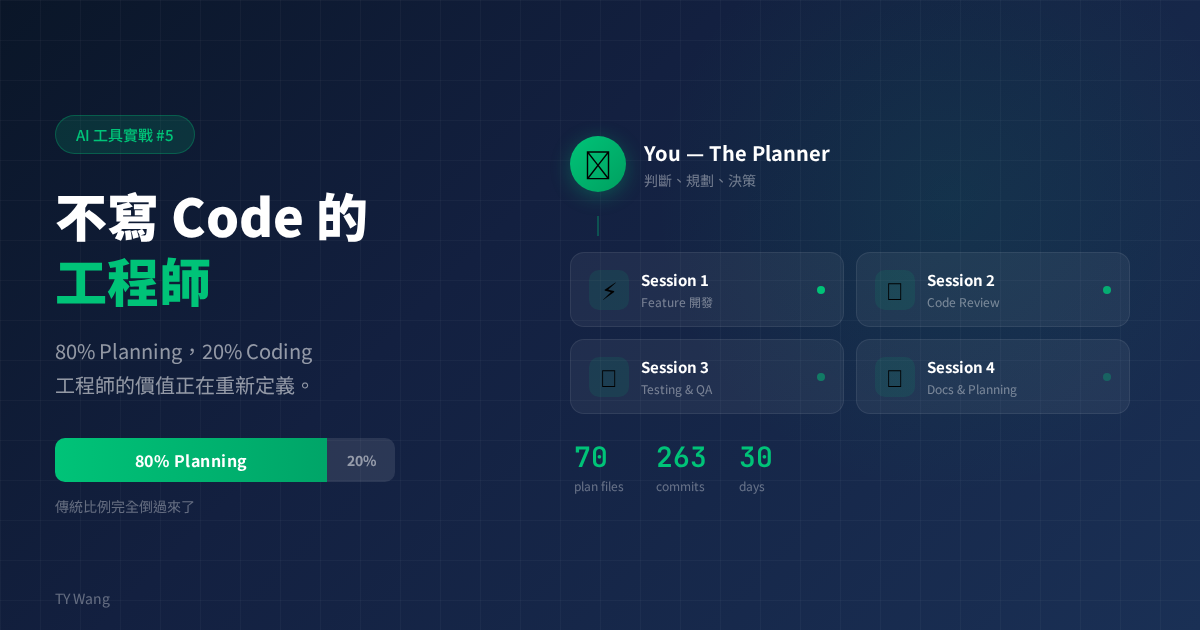
Matt Van Horn is a repeat founder, not a traditional coding-first builder. But he recently shared a Claude Code workflow that produced 263 commits and 70 plan files in 30 days.
Wait, more plan files than commits? Exactly. That is the point.
1. The 80/20 ratio flips
Traditional software work often feels like 80% coding and 20% deciding how to code.
Matt almost flips that ratio: 80% planning, 20% coding.
He spends most of his time speaking ideas out loud, defining requirements, breaking work into tasks, and then running 4-6 Claude Code sessions in parallel. Each session handles a different kind of work: one builds features, one runs tests, one writes docs.
This sounds extreme, but it points to something real: once AI becomes stronger, the bottleneck starts shifting away from writing and toward deciding.
2. Not being an engineer may actually help
There is also a very counterintuitive angle here.
Because Matt is not an engineer, he never gets trapped in "how would I write this code myself?" His frame is always "what outcome do I want the AI to produce?"
That sounds simple, but it is not trivial. A lot of engineers, myself included, can get dragged too quickly into implementation detail. He starts from orchestration because he has no other default.
3. Judgment becomes the real scarce skill
So where does engineering value move?
My experience leading product and engineering at dentall is that, as AI tools get better, "can this be implemented?" is becoming less scarce than it used to be. What stays scarce is judgment:
- what should be built
- what should wait
- what should be avoided
- where the traps are
That kind of judgment comes from scars, commercial context, and knowing why the previous version broke. AI still does not carry that very well.
4. plan.md may become more important than people expect
Another practice from Matt that I really like is how seriously he treats plan.md.
Product specs, competitive analysis, strategy notes, even article drafts all start with a plan. That sounds simple, but once planning becomes the entry point of the workflow, the whole shape of the work changes.
When I was building LINE AI Bridge, I was running into a very similar need: if I get an idea outside, can I set AI in motion right away instead of waiting until I get back to the computer?
5. This is not only about engineers
So the phrase "an engineer who does not code" can also be read in a broader way.
For PMs, designers, marketers, consultants, and founders, work may gradually shift toward:
- 80% planning and judgment
- 20% execution
Once AI lowers the cost of execution, the value of deciding well becomes much more visible.
Closing note
The biggest thing this made me think about is that AI may not only be changing tools. It may be changing where the real center of work sits.
If the old premium was "can you build it yourself," the new premium may be "can you set the direction, structure the work, and place effort in the right order?"
PS
Matt mentioned using Telegram plus a Mac Mini to control AI remotely. The idea is surprisingly close to what I was doing with LINE AI Bridge.
Call it convergent thinking, or maybe just laziness finding the same solution from two directions.